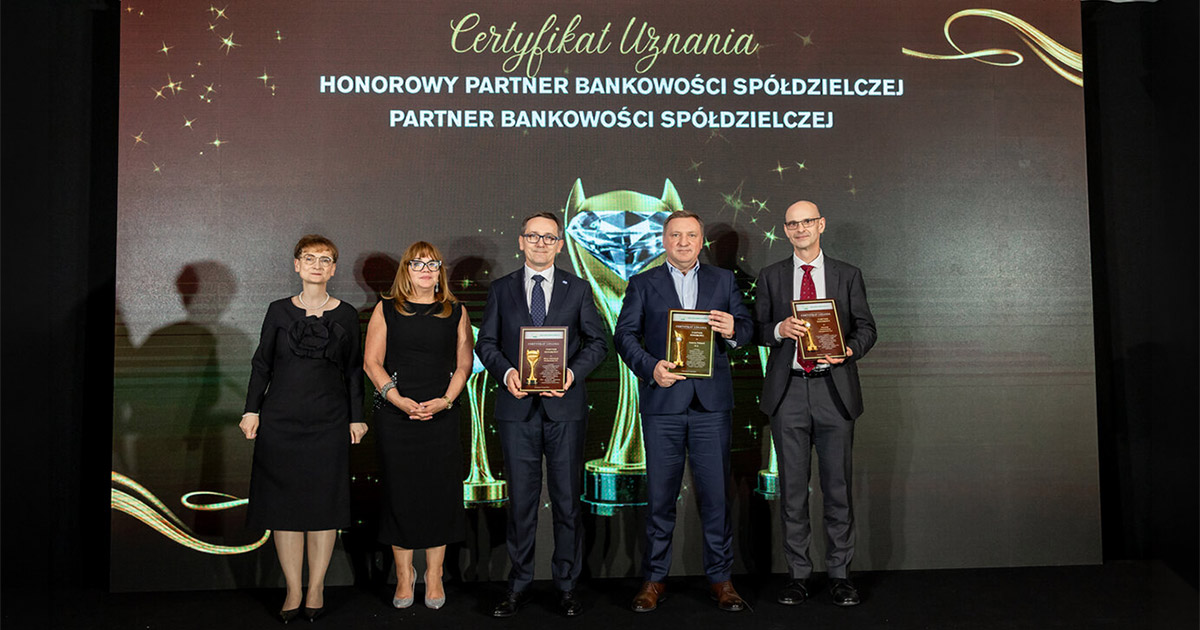
Asseco received a Supporting Member Award from the National Association of Cooperative Banks during the organization's gala celebrating its 35th anniversary. The distinction recognizes Asseco’s long-standing commitment to the development of the cooperative banking sector and its contribution to creating innovative solutions that support banks’ digital transformation.
The award highlights the importance of close cooperation between technology providers and the cooperative banking sector. For many years, Asseco has been delivering IT solutions that support the digitalization of banking processes, enhance operational security, and enable the development of modern banking services for customers.
The anniversary gala brought together representatives of cooperative banks, financial institutions, public administration, and industry partners. The event provided an opportunity to celebrate the Association’s 35 years of activity and its role in representing the cooperative banking sector while fostering a stable environment for the development of local financial institutions.

In the first quarter of 2026, the Asseco Group generated PLN 4.4 billion (EUR 1.0 billion) in sales revenues, of which PLN 3.4 billion (EUR 800 million) came from sales of its proprietary IT products and services. Operating profit was 33% higher than in the comparable period of 2025 and amounted to PLN 513 million (EUR 121 million), while net profit attributable to shareholders of the parent company, after a 68% increase, amounted to PLN 228 million (EUR 54 million).
The Group’s companies systematically built up their backlog for the coming months.
During the reporting period, the Group expanded its operations both in Poland and abroad. Sales revenues in the Asseco Poland Segment increased by 12% to PLN 607 million (EUR 143 million). The segment’s results were supported by Asseco’s involvement in the development of the digital government ecosystem, numerous financial sector transformation projects, and the execution of contracts for nearly half of the hospitals covered by the National Recovery Plan (KPO).
The Group’s results are highly diversified geographically - 86% of sales come from foreign markets represented by the Formula Systems Segment and the Asseco International Segment. Sales in the Asseco International Segment exceeded PLN 1.1 billion (EUR 267 million), representing a 7% increase compared to the first quarter of 2025. Within this segment, the Asseco Central Europe Group recorded revenue growth - particularly for solutions for the public administration sectors in the Czech Republic and Slovakia, as well as ERP systems offered by the Asseco Enterprise Solutions Group. Asseco South Eastern Europe generated strong sales results for core banking solutions. In the Formula Systems Segment, revenue increased by 9% year-over-year to PLN 2.7 billion (EUR 630 million), mainly thanks to the rapidly growing performance of Matrix IT.
“Broad business diversification, strong technological expertise, and proprietary IT solutions remain the foundation of the Asseco Group’s growth. Long-term customer relationships and our presence in strategic sectors of the economy strengthen the resilience of our business model. At the same time, we are expanding the scale of our operations both organically and through acquisitions - in the first quarter of 2026, we completed four acquisitions, strengthening the Group’s position in international markets. We are also expanding our order backlog to support our continued growth in 2026 and beyond,” said Karolina Rzońca-Bajorek, Vice-President of the Management Board and CFO of Asseco Poland.
Asseco’s consolidated order backlog for 2026, in the area of proprietary software and services, currently stands at PLN 12.3 billion (EUR 2.9 billion) and is 21% higher than in the corresponding period a year ago.

Assecohas been recognized as the highest-ranked Polish IT company in the “Europe’sBest Employers 2026” ranking, prepared by the Financial Times incooperation with the research company Statista. The ranking includes 1,000 topemployers across Europe and was based on more than 6 million anonymous employeeevaluations from across the continent.
The“Europe’s Best Employers 2026” ranking recognizes organizations offering thebest working environment, career development opportunities, and the higheststandards of corporate culture. The survey assessed, among others, workingconditions, compensation levels, career prospects, and employer reputation.
Assecois the largest software producer in Central and Eastern Europe and operates inmore than 50 countries worldwide. The company develops solutions supporting thedigital transformation of key sectors of the economy, including finance, publicadministration, energy, healthcare, and telecommunications.
The“Europe’s Best Employers 2026” ranking included companies employing at least500 people and operating in more than one European country.

Asseco has once again been recognized in the prestigious Poland’s Best Employers ranking. Its presence in this list confirms the company’s strong position as an employer that creates a modern and employee-friendly work environment.
The ranking was prepared by Forbes magazine in cooperation with the research company Statista, based on an independent survey conducted among employees of companies with at least 250 staff members. Respondents evaluated i.a. organizational culture, opportunities for professional development, workplace relationships, salary and benefits levels, as well as work-life balance. Companies could neither apply for inclusion in the ranking nor influence the survey results.
Poland’s Best Employers 2026 is a list of 350 companies operating in Poland whose outstanding HR achievements were recognized with the title of best employer. The study was based on a list of approximately 2,000 employers.
For many years, Asseco has been developing solutions that support the digital transformation of key sectors of the economy, delivering projects both in Poland and internationally. The company is the largest software producer in Central and Eastern Europe and operates in more than 50 countries worldwide.

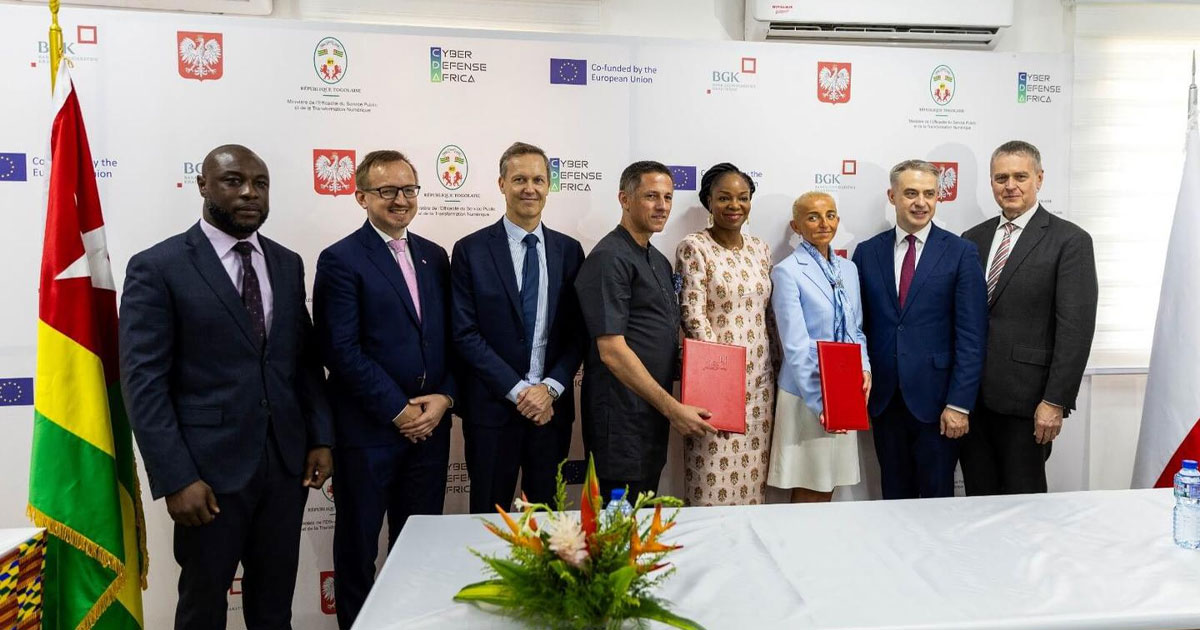
Bank Gospodarstwa Krajowego (BGK) has signed an agreement setting out the terms of long-term financing for a technology project in Togo implemented by Cyber Defense Africa (CDA) – a company established by the Government of the Republic of Togo and Asseco Data Systems. The financing, backed in part by an EFSD+ guarantee under the European Union’s Digital Transformation for Sub-Saharan Africa programme, marks BGK’s first development cooperation transaction.
The investment project, which will be partially financed by BGK, is being carried out by Cyber Defense Africa (CDA), which is a joint venture between the Government of the Republic of Togo and Asseco Data Systems of Poland created in 2019 and providing cutting edge cybersecurity services in Togo and Africa. The financing to be provided by BGK is secured by a EU guarantee under the EFSD+ programme, which has made it possible to mitigate the risks associated with the project. This multi-domain program aiming at the upskill Togolese specialist will last for 12 years and BGK is financing part of the initial start of the project in the value over 24 milion euro.
Poles are among the world’s leading specialists in cybersecurity. These competencies should be used not only to protect national infrastructure but can also serve as a hallmark of our export potential. Additionally, Bank Gospodarstwa Krajowego is an institution with extensive experience in financing complex projects with a public component and in utilizing European Union funds. This investment represents a combination of our greatest strengths and is an important element in strengthening international relations - Deputy Prime Minister and Minister of Digital Affairs, Krzysztof Gawkowski.
Building our technological capabilities is not merely a technical undertaking — it is a matter of national sovereignty and strategic independence. The Security Technology Center embodies Togo’s unwavering commitment to investing in the skills, talent, and expertise that will define its digital and industrial transformation for decades to come. At its heart, this initiative is dedicated to shaping a new generation of highly skilled professionals trained in cutting-edge fields such as systems and networks, artificial intelligence, and the design, development, and operational deployment of drones, alongside other advanced technological disciplines. In the same spirit of ambition, we are proud to announce the creation of the Africa Drone Company, a national platform dedicated to the production, innovation, and operational use of drones across key sectors, serving both Togo’s strategic needs and broader regional applications in Africa. We also take pride in deepening our partnership with Poland, a trusted ally that shares our belief that investing in human capital and technological capability is the cornerstone of sustainable development and long-term prosperity - H.E. Cina Lawson, Minister of Public Service Efficiency and Digital Transformation, Republic of Togo
The project in Togo is just the beginning
BGK supports Africa’s sustainable economic development by focusing on proven, secure and modern European technologies. At the same time, the transaction is a ‘win-win’ – in addition to supporting local digital infrastructure, it contributes to the expansion of Polish business into African markets, while at the same time deepening the technology ecosystem in Togo. For BGK, this is a project of strategic importance. It demonstrates that a Polish development finance institution can effectively contribute to the implementation of EU priorities, whilst supporting the development of partner economies and the competitiveness of European companies. The project in Togo is not a one-off initiative. “We are working on further similar transactions and plan to continue using EFSD+ instruments to strengthen the presence of European, including Polish, companies in African markets - Prof. Marta Postuła, First Vice-President of BGK
Africa’s digitalisation
Cyber Defense Africa (CDA) is a leading entity dedicated to cybersecurity and the defense of critical infrastructures in Africa. CDA operates a modern Security Operations Center (SOC) and provides 24/7 monitoring and incident response services. Additionally, CDA manages the national Computer Emergency Response Team of Togo (CERT.tg), offering free services to strengthen national cybersecurity.
This important project will enable CDA to expand its scope of services by further investing in its technology stack including cutting-edge AI-driven systems as well as human resources, notably by implementing a digital security academy to provide advanced cybersecurity trainings to its personnel as well as to the national and regional workforce - Simon Melchior, CDA’s Director General
The development of modern and secure digital infrastructure is one of the key elements of economic transformation in African countries. We are pleased that, thanks to the support of BGK and the European Union’s EFSD+ programme, we can jointly implement projects strengthening the country’s digital resilience, including in the areas of cybersecurity and digital services. This marks another stage of Asseco’s cooperation with Togo, which has been continuously developed since 2019 - Andrzej Dopierała, CEO of Asseco Data Systems
The funding for CDA forms part of the implementation of the EU’s Global Gateway strategy. Its aim is to develop modern, resilient and secure infrastructure in partner markets, whilst strengthening Europe’s global presence.
The European Union is proud to support this Polish–Togolese partnership in cybersecurity. This is about protecting citizens, public institutions and businesses, while driving new opportunities for the national economy in a thriving sector. It is our first EU-backed digital investment in Togo under Global Gateway, part of a continent-wide strategy to support digital transformation and economic opportunity. This is also team Europe at work, securing a long-term investment by our private sector in Togo - H.E. Gwilym Ceri Jones, Ambassador of the EU in Togo
BGK is the first bank outside the eurozone to be accredited by the European Commission – the so-called Pillar Assessment – which enables it to manage EU funds, including EFSD+. BGK is also the only financial institution in Poland with a mandate to implement projects under the development cooperation framework.
This investment is made under the EU-backed Digital Transformation in Sub-Saharan Africa Programme with support from the European Union and the European Fund for Sustainable Development Plus (EFSD+) and contributing to the EU’s Global Gateway strategy and the Team Europe Initiative.

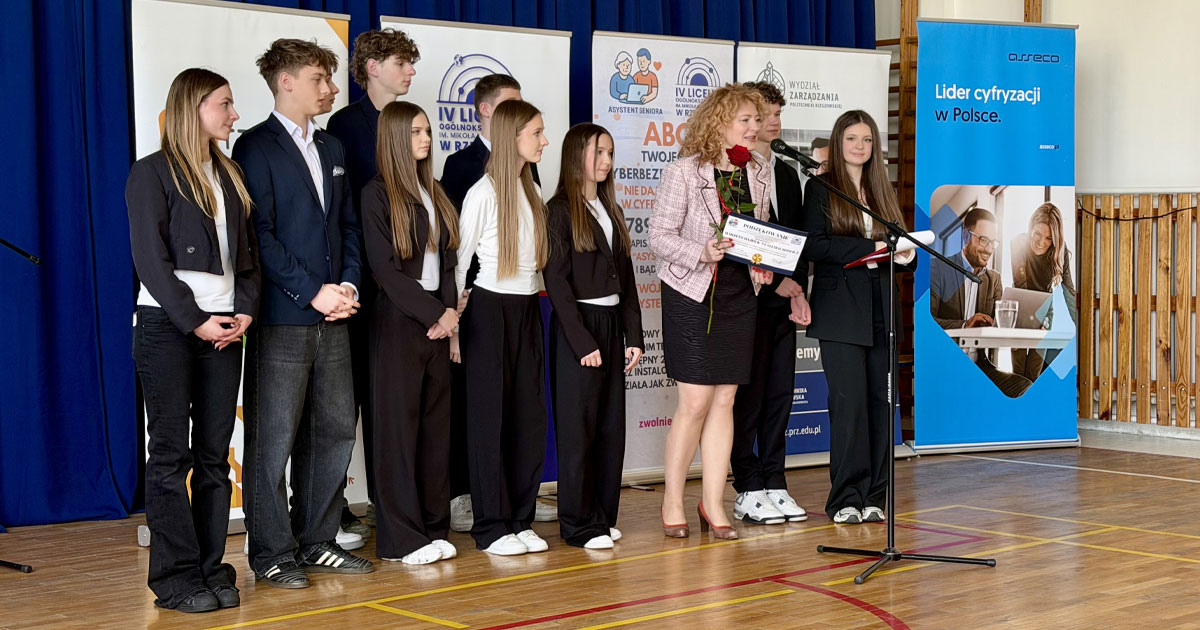
Uczniowie IV Liceum Ogólnokształcącego w Rzeszowie stworzyli rozwiązanie, które może realnie zwiększyć bezpieczeństwo seniorów w internecie. „Asystent Seniora” został zrealizowany w ramach ogólnopolskiej olimpiady Zwolnieni z Teorii, która opiera się na praktycznym działaniu i projektach społecznych. Wykorzystując technologię chatbotową - rozwiązania Pola.ai oraz Infobase.ai od Asseco, młodzież stworzyła asystenta, który pomoże seniorom lepiej odnaleźć się w świecie cyfrowym i zwiększyć ich bezpieczeństwo w sieci.
Projekt łączy nowoczesną technologię z edukacją i bezpośrednim wsparciem użytkowników. Jego celem jest stworzenie trwałej cyfrowej tarczy dla seniorów – rozwiązania, które realnie zwiększa ich bezpieczeństwo w obliczu rosnącej liczby cyberoszustów. Co szczególnie warte podkreślenia, za inicjatywą stoi zespół uczniów klas pierwszych, którzy już na początku swojej drogi edukacyjnej podjęli się realizacji projektu o realnym znaczeniu społecznym.
W projekt zaangażował się Urząd Miasta Rzeszowa, który wsparł uczniów swoim doświadczeniem w pracy z seniorami. Dzięki tej współpracy zorganizowano warsztaty edukacyjne, podczas których młodzież z IV LO przybliżyła seniorom najważniejsze zagadnienia związane z cyberbezpieczeństwem. W udział w warsztatach zaangażowali się także przedstawiciele Centralnego Biura Zwalczania Cyberprzestępczości, eksperci Nadsańskiego Banku Spółdzielczego, a także Asseco Poland.
„Seniorzy to grupa, która szczególnie potrzebuje wsparcia w obszarze bezpieczeństwa cyfrowego. Cieszy nas zaangażowanie młodzieży, która nie tylko zdobywa wiedzę, ale także dzieli się nią z innymi. Współpraca z uczniami IV LO i Asseco Poland to doskonały przykład tego, jak można łączyć edukację, nowe technologie i działania społeczne na rzecz mieszkańców” – podkreśla Andrzej Burnat, Dyrektor Wydziału Polityki Społecznej Urzędu Miasta Rzeszowa.
„Chatboty oraz voiceboty mają ogromny potencjał w obszarze edukacji i wsparcia użytkowników, szczególnie tych, którzy mogą mieć trudności z obsługą tradycyjnych narzędzi cyfrowych. Dlatego, gdy zgłosili się do nas uczniowie IV LO w Rzeszowie, nie mieliśmy wątpliwości, że wykorzystanie naszych rozwiązań – Pola.ai oraz Infobase.ai – pozwoli im zrealizować projekt i stworzyć chatbota zgodnie z ich pomysłem. To bardzo budujące, że młodzi ludzie chcą tworzyć narzędzia o realnym znaczeniu społecznym. Wspieramy ich nie tylko technologicznie, ale również merytorycznie, pomagając przełożyć ich pomysł na funkcjonalne i bezpieczne rozwiązanie” – mówi Jarosław Bryl, Dyrektor pionu Business Intelligence oraz Chief AI Officer, Asseco Poland.
„Udział w olimpiadzie Zwolnieni z Teorii to dla naszych uczniów przede wszystkim możliwość pracy nad projektem o realnym znaczeniu społecznym. „Asystent Seniora” pokazuje, że młodzi ludzie potrafią łączyć technologię z empatią i odpowiedzialnością. Jesteśmy dumni, że mogą rozwijać swoje pomysły w praktyce i jednocześnie wspierać lokalną społeczność” – mówi Lesław Marciniak, Dyrektor IV Liceum Ogólnokształcącego im. M. Kopernika w Rzeszowie.
„To, co najbardziej imponuje, to dojrzałość tych młodych ludzi. Uczniowie nie tylko stworzyli narzędzie, ale przeszli cały proces – analizowali potrzeby, podejmowali decyzje i brali odpowiedzialność za efekt. To nie była symulacja, lecz realny projekt społeczny” – podkreśla opiekun projektu dr Marzena Hajduk-Stelmachowicz.
Za projektem stoi zespół uczniów, który przez wiele miesięcy pracował nad jego koncepcją i wdrożeniem – od analizy problemu, przez projektowanie rozwiązania, po jego testowanie oraz prezentację. Skład drużyny: Miłosz Cupryś, Karolina Skórska, Kamila Rak, Maja Jankowska, Hanna Kielar, Maria Karaban, Bartosz Tendelski, Krystian Bereza, Karol Gawłowski, Hubert Grządziel, dr Marzena Hajduk-Stelmachowicz.
Pozostali partnerzy projektu: GC Energy, Politechnika Rzeszowska.
Projekt „Asystent Seniora” pokazuje, jak nowoczesne technologie mogą wspierać budowanie bezpiecznego i inkluzywnego społeczeństwa cyfrowego, a także jak ważną rolę odgrywa współpraca między młodzieżą, szkołą, biznesem i samorządem w odpowiadaniu na realne wyzwania społeczne. Pilotaż projektu będzie prowadzony do końca maja. W tym czasie zbadane zostanie zainteresowanie seniorów nowoczesnym rozwiązaniem.
„Asystent Seniora” dostępny jest pod numerem: +48 789 440 163.
A package of the most important press materials: multimedia, documents and data about Asseco ready to use.


This website uses cookies and other tracking technologies to assist with navigation and feedback, analyze the use of our products and services, support our promotional and marketing efforts, and provide content from third parties. View more cookie settings to manage your preferences.
More information about cookies and data storage can be found in our Privacy Policy.