The Social Insurance Institution (ZUS) is a state organizational unit, which collects social and health insurance contributions of citizens and pays benefits (for example pensions, disability, sickness or maternity benefits). Since its establishment, it has been one of the most modern and best organized institutions of this type in the world.
Currently, more than 25 million customers use ZUS’s services, which puts it in the top position among the largest financial institutions in Poland. The Social Insurance Fund’s financial resources, which, in accordance with the regula- tions, are distributed by ZUS, account for more than 30% of the state’s financial funds.
The reform of the social security system
In 1999, a reform of the social security system was introduced. Among its basic assumptions were:
- commencement of collecting information on insured persons and contributions to individual accounts of these persons - on the basis of information provided by employers,
- calculation of initial capital, being a summary of pension contributions paid before 1999 - on the basis of documentation provided by the insured persons,
- from 2005, informing the insured about the contributions accumulated on their individual accounts,
- transferring part of the pension contribution to specialized financial institutions for investment.
Before the pension reform, in the area of social security contributions collection, ZUS served only companies as contributors and did not maintain individual accounts of insured persons. Employers paid one contribution, calculated on the basis of the whole wage fund. Payers had to send about 18 millions of settlement documents per year. Before 1999, each person applying for a retirement pension in Poland was obliged to collect and present to ZUS documents confirming their employment history. As a result, it was difficult to gather reliable evidence for a person applying for a retirement pension, often entailing the need to search for the files of companies that no longer exist.
As a result of the reform, since January 1999, insured persons have had their own accounts in which information about paid insurance contributions have been collected on an ongoing basis. Employers are obliged to report the individual contributions and make monthly payments for each employee. Their contributions are distributed between the four social security funds (pension, disability, sickness and accident) and the health insurance fund. A separat- ed part of the contribution is managed and multiplied by financial institutions selected by the insured person - the Open Pension Funds (OFEs).
In order to handle the new tasks, it was necessary to design and implement an automated information system, which would ensure the reliability of contribution records and efficient flow of information between all the entities participating in the system, in particular ZUS and OFE contribution payers.
Whereas before the reform payers had to submit about 18 millions of documents, after the reform that number increased by 13 times to 260 million documents. It was also necessary to develop tools for contribution payers, supporting the preparation of documents, and work out and effective method of transferring documents to ZUS.
The new solution’s main goal was to launch systems dealing with:
- secure electronic transmission of documents,
- automatic scanning and recognition of paper documents,
- verification of data and support of error-explaining processes, where an important element was a computer program distributed among contribution payers (the “Payer” program),
- full automation of settlements on the accounts of payers and insureds,
- electronic data exchange with institutions such as the National Health Fund (formerly the Health Care Fund), OFEs, the Ministry of Interior and Administration (MSWiA), the Ministry of Finance (MF), the Central Statistical Office (GUS) and banks,
- calculation and payment of long-term and short-term benefits in line with the principles of the reform.
KSI ZUS
It serves 25 million customers and settles 1/3 of the state’s financial funds
In order to achieve the assumed objectives, most of the IT tools had to be developed from scratch during the implementation of the pension reform. The target solution was to support all the processes implemented by ZUS, and its development had to be conducted in parallel with works on the detailed legislative changes. Therefore, in 1997 ZUS signed an agreement for the design, development and implementation of the Comprehensive Information System (KSI). Asseco Poland became the General Contractor of Investment (GRI) responsible for the implementation of the entire system. The order covered not only the functionality necessary to implement the changes in the system of contribution collection and maintenance of individual accounts, but also modules dealing with:
- granting and paying out benefits on the basis of new, reformed rules,
- supporting assessment and rehabilitation processes,
- supporting process of controlling the payers of contributions and, in the event of detection of irregularities, enforcing the claims,
- developing statistical analyses,
- informing the competent authorities of the status of the accounts.
The development of the system
KSI ZUS is a centralized system - all information assets are stored and processed in the so-called Central Computer. Currently, it consists of three IBM Z Platforms which are connected to each other in IBM’s Parallel Sysplex and function as a single multiprocessor computer. Part of the system is located in the Central Computing Centre, while the other elements are located in the Backup Central Computing Centre.
Initially, the development of the IT solution focused on creating a fully automated central system software and relatively simple interactive applications, enabling direct access to KSI’s data. Subsequently, functionalities supporting the data validation processes and resolving discrepancies were launched. They have been made available to employees in field units. They are based mainly on applications that have access to central data, and sometimes on information collected in branch databases.
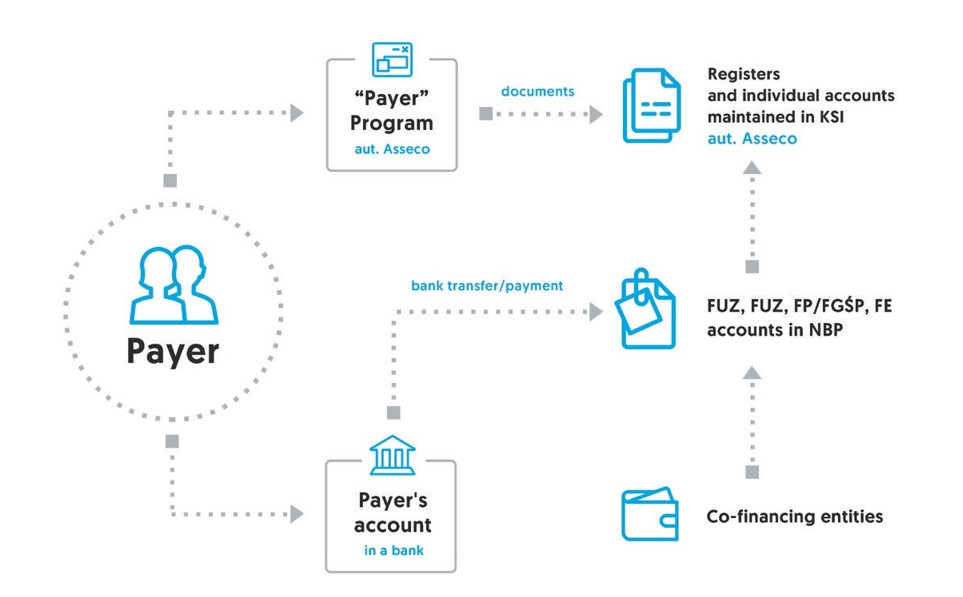
The ZUS Centre is also equipped with database and application servers based on the UNIX system. They collect some of the data and support access to them from the Central Computer, acting as application servers. The functioning of the system is supported by Workflow and Business Intelligence solutions, which ensure its flexible operation, auto- mation of tasks, standardization of procedures and performance analysis at the central, regional, local and individual levels. In addition to the modules used by ZUS’s employees, KSI ZUS also includes the so-called „Payer” program - enabling users to prepare, verify and send insurance documents to ZUS view the status of individual accounts.
How it works
In order to properly organize the data collected by ZUS, the so called central registers have been created. They store the data gathered from various entities and include: the Central Register of Contribution’ Payers (CRP), the Central Register of Insured Persons (CRU) and the Central Register of Open Pension Fund Members (CRC OFE). The records of contributions are kept on individual accounts maintained in the IT system. The contribution’s separated part earmarked for the Second Pillar is sent to OFEs on regular basis. In parallel with the reform of the social security system, a general health insurance was introduced, and the contributions registered by the company on this account are transferred to the National Health Fund (formerly to the Health Insurance Funds), similarly as the pension contributions to OFEs.
The documents from payers are transferred to ZUS via the EDI system. If they are in paper form, they are replaced by an electronic version. If they are sent electronically, they are received at one of the Internet gateways. Regardless of the document’s original form, only the digital data are transferred to the central system.
KSI ZUS system is developed based on both commercial and open-source technologies. ZUS’s team and Asseco’s 300 specialists are responsible for its maintenance.
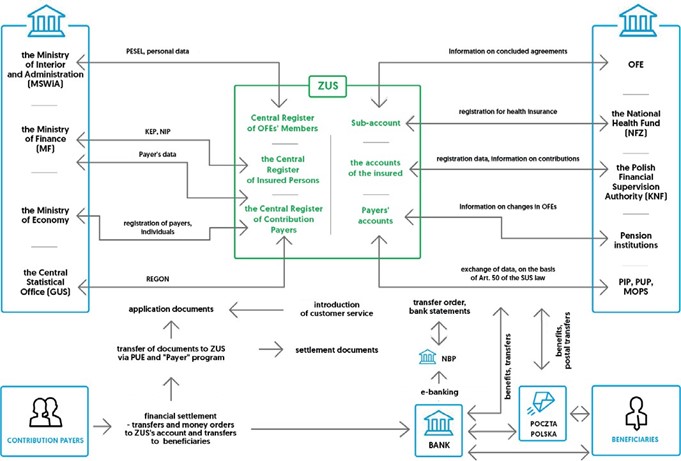
ZUS also receives information from OFEs in electronic form - they regard concluded contracts or changes to the funds (the information are encrypted, signed digitally and sent by the funds to the relevant website). The contributions made by a payer via a bank are electronically transferred to ZUS by the National Bank of Poland (NBP). The payments have to go through a payer’s data identification process and are then booked in the payer’s account. The system then settles the payments to cover the benefits that have to be sent to the insured. In case of an incomplete payment, the contribution amount is covered proportionally between the insured persons.
The contributions settled on the accounts of the insured, who are members of OFEs, are the basis for creating contribution lists to OFEs. At this stage, the affiliation of the insured to the funds is verified and once a week the lists are sent electronically to OFEs (encrypted and signed). : On the next working day, collective transfers are conducted, and OFEs, based on the lists, divide the amounts on the accounts of insureds in their IT systems.
Electronic Document Exchange Platform
KSI ZUS processes more than 900 million documents per year, which is why one of its main elements is the Electronic Document Exchange Platform (EPWD). It is a workflow class solution (as defined by Workflow Management Coalition), which automates more than 300 types of business processes with the use of the BPEL engine and documentation digitization modules.
The system is used by more than 30,000 people via a web browser, located in more than 300 geographically dis- persed locations. Both the documents and the tasks analyzed and distributed cover various substantive areas, including certificates of no contribution arrears, certificates confirming individual insurance history or applications for reimbursement of overpaid contributions.
Thanks to legal regulations and technological development, more than 90% of documents are electronically transferred to ZUS (mainly via the „Payer” Program). The vast majority of them are processed automatically by KSI ZUS. ZUS’s departments are only involved in the case of critical errors and doubts with a significant financial impact.
The advantages of the system
KSI ZUS has facilitated the implementation of tasks for all institutions involved in the pension reform. It has also brought numerous benefits to payers and insured persons. The insured persons receive information about contributions accrued in their accounts, thanks to which they are able to control the amount of their future retirement benefits. In addition, they do not have to struggle with the difficult task of finding documents confirming their employment history.
Employers, on whom the pension reform has imposed a number of additional obligations, can now benefit from a convenient, electronic form of settlement. The use of an electronic system reduces the risk of errors and is an effective tool for data verification.
OFEs use ZUS’s infrastructure and its contributions collection capabilities, thus reducing the costs of their own operations and the fees paid by insured persons. They also use the electronic system as a means of communication with ZUS. The same applies to NFZ, which uses the services of ZUS in the area of collecting contributions for health care.
Thanks to the automated settlement system, ZUS is able to fulfill the obligations imposed on it by the reform. In addition, thanks to the system, ZUS can provide its customers with safety and high level of services. The customer service time has been shortened. Customers have also received access to information about the status of their case. Paper documents have been removed from circulation wherever possible - they have been digitized and secured.
KSI ZUS has been awarded the main prize in the „eEurope Awards for eGovernment - 2005” competition for the best IT system for state administration, organized by the European Institute of Public Administration.
The system has been also appreciated by the editorial staff of Computerworld magazine, which has awarded KSI ZUS with a special award during the „Computer Science Leader 2017” gala.